
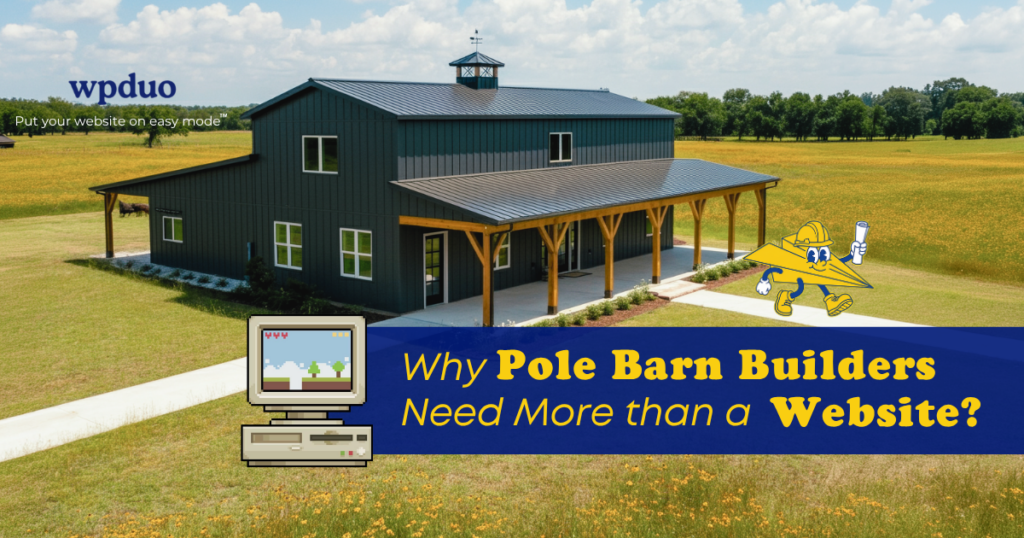
Why Pole Barn Builders Need More Than a Website
A website that doesn’t generate leads is a digital brochure. The pole barn builders who are booking six months out aren’t doing it because they have a better-looking site. They’re doing it because their website is the conversion layer for a system that actively puts qualified prospects in front of them.
We built that system for a Midwest pole barn company. In two years, they went from 10 buildings sold to 39. Revenue grew from $600,000 to over $2.3 million (and that estimate is conservative, based on starting project values of $60,000 each; many custom builds go higher). Their total ad spend was $33,000, which produced a 71x return on the low end. They generated 2,048 leads in 2025 at an average cost of $18 per lead. And 50% of all traffic hitting their website now comes from the paid campaigns we manage.
This post breaks down what that system looks like, why it works for construction specifically, and what a builder should do first if their website isn’t pulling its weight.
What Does a Lead Pipeline Look Like for a Pole Barn Company?
A pipeline is a connected system where each piece feeds the next. It is not a website. It is not an ad campaign. It is what happens when those things work together.
For the construction company we work with, the system looks like this: Paid ads on Meta and Google drive targeted traffic to the website. The website includes interactive tools, like a metal building color visualizer, that keep visitors engaged and move them from browsing to requesting a quote. Those leads flow into a CRM where the sales team follows up. The ads get optimized monthly based on what’s actually closing, not just what’s clicking. And the content on the site keeps building organic search traffic over time.
None of those pieces work alone. A great website with no traffic is invisible. Ads pointed at a slow, confusing site are expensive clicks. Leads that hit a CRM with no follow-up process are wasted money. The pipeline works because every piece is connected.
How Did a $600K Construction Company Reach $2.3 Million in Two Years?
They built the system, then scaled what worked. Here’s the real progression.
2024: 10 buildings sold. $600,000 in revenue. About $18,000 in total ad spend across Google and Meta. They had a website and some ads running, but there wasn’t a system connecting the two.
We told them: double your ad budget and we’ll double your buildings.
2025: 39 buildings sold. 20 of those directly attributable to paid campaigns. $2.35 million in revenue on $33,000 in ad spend. That’s 292% revenue growth on roughly double the ad investment.
The detailed numbers:
- 2,048 total leads generated across all channels
- $18 average cost per lead
- 1,144 conversions from Google at $12.89 per conversion
- 904 leads from Meta at roughly $24 per lead
- 50% of all website traffic from paid sources
- Building revenue starting at $60,000 per project (custom builds often go well beyond that)
2026: Budget scaled to $51,000 planned for the year. Through Q1, they’ve spent $12,220 in ads. The system keeps compounding because the fundamentals are proven.
The key insight here is that the revenue didn’t grow because the market got better. It grew because the system got tighter. Better targeting, better creative, better follow-up, better conversion on the site.
Why Does Paid Advertising Work So Well for Construction Companies?
Three characteristics make construction unusually suited to paid media.
High project value. These are custom buildings. Projects start at $60,000 and go up from there depending on size, design, and use. When your cost per lead is $18 and a single closed project is worth $60K or more, you don’t need volume. You need the right 30 or 40 leads to close in a year.
Long sales cycle. Pole barn buyers take months from first inquiry to signed contract. That’s actually an advantage because paid media builds a compounding pipeline. The leads you generate in January close in April or June. You’re always filling the top while the middle works through.
High intent. People searching for pole barns, barndominiums, and metal buildings are planning to spend serious money. You’re not creating demand. You’re capturing intent that already exists and directing it to the right builder.
The combination of these three things means that even a modest ad budget can produce outsized returns. This company spent $33,000 in ads and generated $2.35 million in revenue. That math doesn’t happen in every industry. Construction is one of the few where it consistently does.
What Role Does the Website Play in Generating Leads?
The website is the conversion layer, not the traffic source. Its job is to turn visitors into leads.
For this client, the most effective feature on the site is a color visualizer tool. It lets visitors pick metal colors, roof combinations, and trim options for their building. It sounds simple, but it does two things that matter: it keeps people on the site longer (engaged visitors convert at higher rates) and it moves them from “just looking” to imagining their specific building. That psychological shift is where quotes start.
Beyond the visualizer, the site is built around the questions buyers actually ask. Page content covers building dimensions, site prep requirements, regional pricing, and design options. Every page answers a question and makes it easy to take the next step.
The organic results back this up. The wpDuo website already ranks for dozens of construction keywords. “Metal building color visualizer” alone generates over 3,100 impressions per year. “Pole barn color combinations,” “barndominium color visualizer,” and “steel building color schemes” all rank in the top 10. That organic traction happened because the content matches what real people search for. Paid ads amplify it, but the site does work on its own when it’s structured correctly.
What Is the Difference Between a Website and a Pipeline?
A website is something you have. A pipeline is a system you run.
A website sits on a server and waits. A pipeline actively puts your company in front of the right people, brings them to a site built to convert, captures their information, and gives your sales team everything they need to close.
The Midwest builder we work with had a website before we built their pipeline. They sold 10 buildings a year. The website alone didn’t change that. What changed it was wrapping a system around the website: ads driving the right traffic, a visualizer keeping people engaged, a CRM organizing follow-up, and monthly reporting that showed what was working so we could invest more in what converted.
That’s the difference between a $600K year and a $2.3M year. Same builder. Same market. Different system.
What Should a Pole Barn Builder Do First?
If your website isn’t generating leads, the first step is diagnosis, not a redesign.
Figure out where the breakdown is. Is it traffic? Nobody’s finding your site. Is it conversion? People visit but don’t reach out. Is it follow-up? Leads come in but nobody calls them back fast enough. Each problem has a different fix, and spending money on the wrong one is how builders end up frustrated with “marketing that doesn’t work.”
The second step is understanding that a pipeline is a system, not a project. You don’t build it once and walk away. You run it, measure it, and optimize it every month.
The third step is working with a team that understands construction marketing specifically. The terminology matters. The sales cycle matters. The visual assets (drone footage, completed builds, color visualizations) matter. Getting those details right is the difference between ads that convert and ads that waste budget.
Frequently Asked Questions
How much should a pole barn builder spend on digital marketing?
There’s no universal number, but here’s a real reference point. The construction company in this case study spent $18,000 on ads in 2024 and generated $600,000 in revenue. In 2025, they spent $33,000 and generated $2.35 million. Start where you can, measure everything, and increase investment as the returns prove out.
Does paid advertising work for long sales cycle industries like construction?
It works especially well. Because the sales cycle is months long, paid media builds a compounding pipeline. Leads generated today become closed deals three to six months from now. The key is having a CRM and follow-up system that keeps those leads warm through the full cycle.
What kind of website features help convert construction leads?
Interactive tools like color visualizers are highly effective because they move visitors from passive browsing to active engagement. Beyond that: fast load times, mobile optimization, clear calls to action, and content built around the specific questions buyers ask (dimensions, pricing, site prep, regional availability) all contribute to higher conversion rates.
Is SEO or paid media more important for metal building companies?
They do different jobs. Paid media generates leads now. SEO builds organic visibility over time. The strongest approach uses both. For the client in this case study, 50% of their site traffic comes from paid and 50% is organic. Paid campaigns capture high-intent traffic immediately. Blog content and optimized pages build search rankings that generate free traffic month after month.
What is the average cost per lead for pole barn marketing?
It varies by market and competition, but the company in this case study averaged $18 per lead across Google and Meta in 2025. Google specifically delivered conversions at about $13 each. Those numbers are achievable when the targeting is specific and the landing experience is built to convert.

Rob Odell
Rob's marketing career spans over a decade, evolving from mastering the intricacies of paid ads and SEO to architecting full-scale growth strategies as a Chief Marketing Officer. Known for his strategic acumen and direct approach, Rob excels in synthesizing insights from his diverse experiences to craft growth plans that drive businesses forward. He is driven by his commitment to perpetual learning and generating tangible results. Connect with him on LinkedIn
Comments are closed.